Whiteboard Animation vs 2D Animation: Which One to Pick


Whiteboard animation vs 2D animation comes down to one question: is your video explaining an idea, or telling a story about a character? Whiteboard animation draws the idea in black lines while a narrator explains it. It’s cheaper and faster to make. 2D animation puts colored characters in motion, so it carries emotion and brand style better, and it costs more at every level from freelancer to studio. Below are real studio prices and timelines for both, what each style is good at, and a pick for each common type of video.
Create a whiteboard video in minutes
Turn any idea into a hand-drawn whiteboard animation with script, voiceover and drawing done for you.
Key takeaways
- Whiteboard is a type of 2D animation. The difference is what moves: in whiteboard the drawing appears line by line, in character 2D the characters act.
- At studios the price gap is smaller than most comparison pages suggest. Broadcast2World quotes flat 2D and whiteboard in the same tier (from $2,400 per 60 seconds) and custom 2D from $3,500.
- The big gap is in doing it yourself. Whiteboard software and AI generators produce a finished video in hours or minutes. Character 2D still needs someone to animate it.
- Production time follows complexity: about 4 to 5 weeks for a 60-second whiteboard video at an agency, 5 to 6 for flat 2D and 7 to 9 for 2D with characters, by Yans Media’s estimates.
- Pick whiteboard for lessons, processes, abstract ideas and anything you’ll update. Pick 2D for brand campaigns, product launches with a mascot, emotional stories and comedy.
- No study has compared the two styles head to head. The learning research that exists tested whiteboard against slides and static pictures.
What’s the difference between whiteboard and 2D animation?
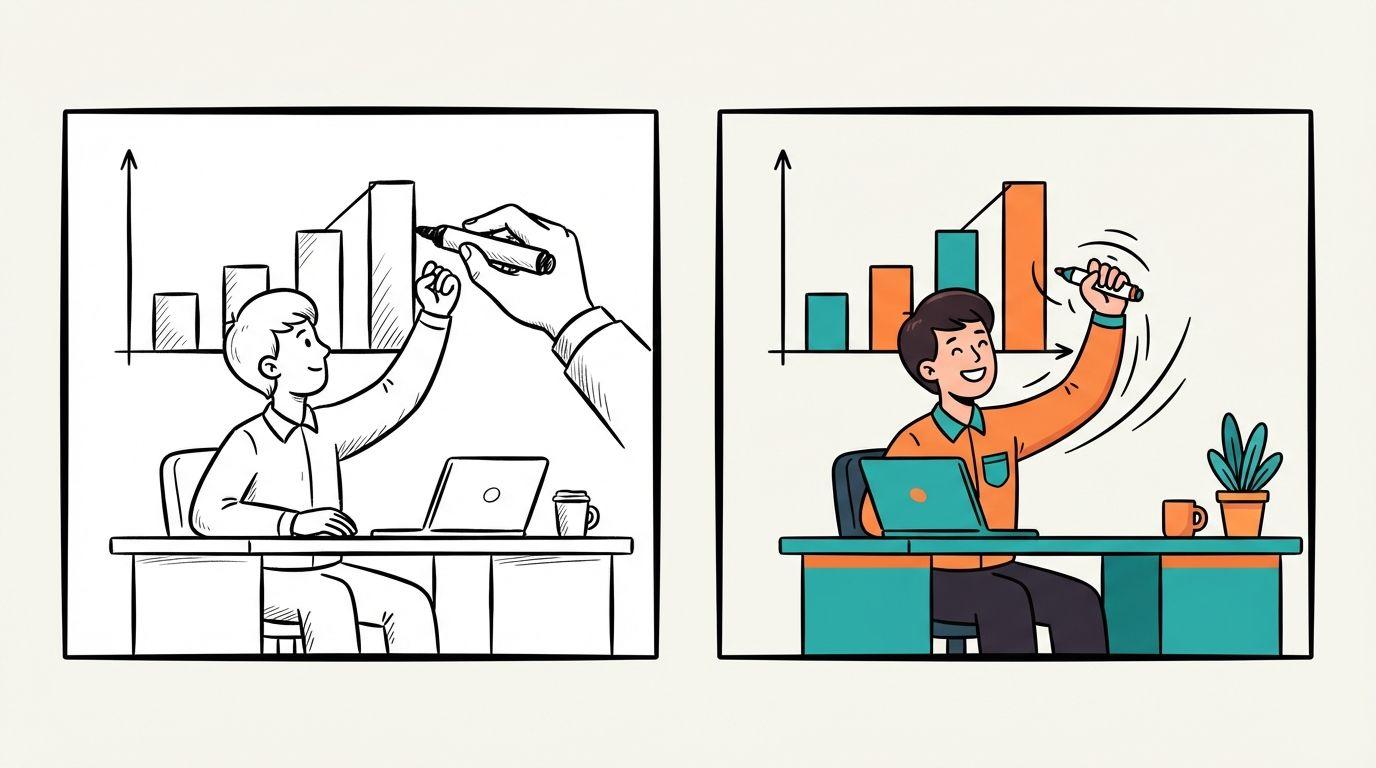
Both are flat, two-dimensional pictures, so whiteboard animation is technically one style of 2D. In practice, “2D animation” means colored scenes where characters walk, talk, react and change expression, the way they do in a cartoon or a SaaS explainer with a mascot. Motion graphics, where shapes and text slide and morph, usually sit in the same bucket.
Whiteboard animation keeps a white background and black line art, sometimes with one or two accent colors. A hand (or a pen tip) draws each picture while the voiceover explains it. Nothing much moves once it’s drawn. The motion is the drawing itself, which tells the viewer where to look.
That one difference drives everything else. Animating a character means drawing many frames of the same figure in slightly different poses, keeping it consistent, and syncing its mouth to the voice. Drawing a whiteboard scene means one illustration per idea, revealed over a few seconds.
Whiteboard animation vs 2D animation at a glance
Whiteboard animation vs 2D animation at a glance
How much each costs
Studio prices for the two styles overlap more than vendor blogs admit. Several animation studios say whiteboard is cheaper than 2D without giving numbers. The ones that do publish numbers put them close together:
How much each costs
Sources: Broadcast2World, Yum Yum Videos, Pixune.
The reason is that a studio’s price is mostly script, storyboard, voiceover and revision rounds, and those cost the same whatever the style. Yum Yum Videos says whiteboard “often cost slightly less” than other custom 2D styles. Where 2D gets expensive is character animation: a figure that walks and lip-syncs takes far more drawing than a figure that appears once and stays put. That’s why the top of Yum Yum’s 2D range ($25,000 a minute) is twice the top of its whiteboard range.
The real gap opens when you make it yourself. Whiteboard tools are built around a library of drawings and automatic draw-in, so a non-animator can finish a video. Our whiteboard animation cost guide breaks down the agency, freelancer, software and AI options. For 2D, template tools exist: Vyond starts at $699 a year for one user and gives you prebuilt characters and scenes. You still place and time every action yourself, and a custom character that doesn’t come from the template library means hiring an animator.
How long each takes
At an agency, a whiteboard video is usually a week or so faster. Yans Media estimates 4 to 5 weeks for a 60-second whiteboard or line-art video, 5 to 6 weeks for 60 seconds of flat 2D or motion graphics, and 7 to 9 weeks for a 60 to 90 second 2D video with characters. Each extra 30 seconds adds about 1 to 1.5 weeks.
Most of those weeks go to the script, storyboard, voiceover and review rounds, which take the same time for either style. If you have an approved script and one person who signs off, you take weeks off either schedule.
Making it yourself, the difference is larger. A whiteboard video from software takes hours: you pick a drawing for each line of the script and time it to the voice. An AI whiteboard generator does the drawing and timing for you in a few minutes. Character 2D in a template tool takes longer because you set each character’s poses and expressions by hand, scene by scene.
What whiteboard animation does better
Whiteboard wins when the video’s job is to make someone understand something. A process with handoffs, a formula, a policy, the reason a product works the way it does: you’d explain each of these by sketching on a whiteboard in a meeting, and the video does the same thing. Because only the new line moves, the viewer looks where the narrator is talking.
It also holds up at length. A 6-minute lesson in character animation is a short film’s budget. A 6-minute whiteboard lesson is the same work as a 2-minute one, just with more scenes. That’s why it’s common in online courses and YouTube education channels.
And it’s easy to keep current. When a price or a step changes, you redraw one scene and re-record one paragraph of narration. In 2D, the same change can mean re-animating a character through a whole sequence.
What 2D animation does better
2D wins when the viewer has to feel something or remember a brand. Viewers feel more for a character they can watch react, frustrated with the old way and relieved with yours, than for a line drawing. Comedy depends on timing and expression, which is exactly what character animation is for.
It’s also where brand identity lives. You can animate in your own colors, with your own mascot, and reuse that mascot across ads and social posts for years. Whiteboard videos tend to look alike because the format strips away color and style.
And it fits short, fast placements. A 15-second ad or a product launch teaser needs motion from the first second. A whiteboard drawing takes a few seconds to appear, which is fine in a lesson and slow in a feed.
What the research says (and what it doesn’t)
No study we could find has tested whiteboard against character 2D animation. The experiments that exist compare whiteboard to formats that don’t move.
Logan Fiorella and Richard Mayer (Journal of Educational Psychology, 2016) found that students who watched an instructor’s hand draw diagrams did better on application questions than students who saw the finished diagrams, though Fiorella later called the effects “relatively subtle”. Mark Brosnan and Tim Hasso (Smart Learning Environments, 2025) had 521 people learn introductory accounting from a whiteboard animation, a narrated slideshow, narration alone or text alone. The whiteboard group learned the most, and the gap held a week later.
So the evidence supports whiteboard for teaching compared with slides. It says nothing about whether a cartoon would have done better or worse. Anyone telling you one style “converts” or “retains” X% more than the other is quoting their own client results.
Which one to pick for your video
Which one to pick for your video
When it’s a close call, look at how many videos you need. One flagship brand video a year can carry a 2D budget. A course of 30 lessons or a weekly channel almost always ends up whiteboard, because nobody can afford 30 character-animated films.
Mixing the two
You don’t have to choose for a whole project. Studios often draw the explanation in whiteboard style and add a colored character for the intro and ending. A brand can also keep whiteboard for training and how-to content and save 2D for ads, where its look matters most.
How to make either one with AI
ShortsCrafter makes whiteboard videos from a topic or your own script. You pick one of four styles (minimalistic, regular, colored or stick figure) and a voice from the library, or your own cloned voice. Vertical videos run 30 to 90 seconds for Shorts and TikTok; horizontal ones run from 1 to 10 minutes for YouTube and courses. Generation takes 2 to 4 minutes on average. Before you render, you can redraw a scene, add or delete scenes and regenerate the voiceover. If you’re writing your own script, plan on 250 to 350 words for a 1 to 2 minute video.
For a cartoon look, ShortsCrafter’s faceless videos come in illustrated styles such as Cartoon, Anime and Adult Animation. A consistent-character option keeps the same character across scenes, and Add motion turns a scene’s still image into a short animated clip. That gets you colorful, character-led videos without an animator. It isn’t frame-by-frame character animation: characters don’t lip-sync or act out a scripted gesture, so a brand mascot campaign still needs a studio.
The plans table shows how many videos each plan covers.
FAQ
Is whiteboard animation a type of 2D animation?
Yes. Both are flat, two-dimensional pictures. “2D animation” usually means colored character animation or motion graphics, and whiteboard is the style with black line drawings that appear on a white background as a narrator explains.
Is whiteboard animation cheaper than 2D animation?
Usually, but at studios the difference is small. Broadcast2World prices whiteboard and flat 2D from the same $2,400 per 60 seconds. Character animation is what pushes 2D prices up. Made yourself with software or AI, whiteboard is much cheaper because no one has to animate anything.
Which is better for explainer videos?
Whiteboard for explaining how something works, especially when the video runs longer than two minutes. 2D for explainers that sell a brand, where a character and your colors matter more than the step-by-step logic.
Which is better for e-learning?
Whiteboard, in most cases. Lessons run long and change often, which suits whiteboard. Research on drawn lessons found a learning advantage over slides and static diagrams.
How long does it take to make each?
At an agency, about 4 to 5 weeks for a 60-second whiteboard video and 5 to 9 weeks for 60 seconds of 2D, depending on whether it has characters. With an AI whiteboard generator, a few minutes.
Can AI make 2D animation?
AI tools can generate illustrated scenes in a cartoon style and add short motion to each one. They don’t yet replace a character animator for lip-sync or for a mascot that has to look identical in every frame.