8 Whiteboard Animation Examples and What Makes Them Work


A whiteboard animation is a video where a hand sketches the story on a white background while a narrator tells it. Good whiteboard animation examples share one habit: every sentence gets a simple drawing, so the viewer always knows what the narrator is talking about. The format suits almost anything that needs explaining, from a 40-second TikTok to a two-minute lesson, which is why teachers, trainers, marketers and faceless YouTube channels all use it. Below are eight examples across those uses. Six were made with ShortsCrafter and play right on this page, so you can watch each one and borrow what fits your own video.
Create a whiteboard video in minutes
Turn any idea into a hand-drawn whiteboard animation with script, voiceover and drawing done for you.
Key takeaways
- Pick the format before anything else. Five of the six videos here are vertical shorts between 37 and 71 seconds; the science lesson is horizontal and runs two minutes.
- Every scene carries one idea. When a topic has several parts, each part gets its own drawing instead of sharing one crowded board.
- The style follows the audience: minimalistic stick figures for a quick psychology short, clean line art for explainers, full color for a story.
- Short text cards on top of the drawing repeat the one line the viewer should remember, in five to eight words.
- The classics (RSA Animate, the UPS whiteboard ads) were drawn by hand and still hold up for the same reason: the drawing shows exactly what the voice is saying.
The examples at a glance
The examples at a glance
Whiteboard animation examples for shorts
Vertical videos for TikTok, YouTube Shorts and Reels. Each one has a few seconds to earn the next few, so every video opens on its point.
1. Why your brain makes you procrastinate (psychology short)
Procrastination is one of the most popular topics in the self-improvement corner of YouTube, where faceless channels post daily. Almost everyone has put off a task they could have finished in ten minutes, so the viewer recognizes the problem before the narrator finishes the first line. The usual angle is the same one this video takes: we put things off because the brain wants to escape a bad feeling, and the fix is to make the first step smaller.
What to notice: the drawings stay as simple as they get, a stick figure and a few icons. The to-do list grows into a mountain with the figure standing at its foot, and the whole message lands on a text card that reads “make the first step tiny”.
2. How compound interest turns small savings into wealth (finance short)
Compound interest is a staple of personal finance channels because it’s simple to state and hard to feel: your interest starts earning interest of its own, and the money you put in first grows the most. Numbers read as abstract when they’re only spoken. Drawn as stacks of cash next to a person, they become something the viewer can compare at a glance.
What to notice: the same character returns in every scene, so the viewer follows one saver instead of a list of figures. The $100 and the $5 it earns sit in two separate stacks, and a snowball rolling downhill stands in for growth that speeds up over time.
3. Why every business needs a CRM (business explainer)
A CRM (customer relationship management software) keeps every customer’s emails, calls, orders and notes in one record. It’s the kind of topic a software company puts on its landing page or runs as an ad, and it explains well on a whiteboard because the problem is easy to picture. Most small teams have lost a lead in an inbox, a sticky note or a spreadsheet nobody updates.
What to notice: the problem comes first. A man buried in spreadsheets and sticky notes sits under the card “Customer details are scattered everywhere”, and only then does every channel point into one CRM folder.
4. The boy who cried wolf (story)
Stories are where the colored style pays off. The boy, his red vest and the green hill stay the same from scene to scene, so even at phone size the viewer never loses track of who is who. This one is Aesop’s fable, retold in under a minute from this script:
A shepherd boy watched the village sheep on a hill above town. The days were long and nothing ever happened. So one afternoon, just to see what would happen, he ran down the hill shouting, “Wolf! Wolf!” The villagers dropped their tools and raced up the hill. There was no wolf. The boy laughed so hard he fell over, and the villagers walked home angry. A week later he did it again. Again they came running, and again there was nothing. This time nobody laughed. Then one evening a real wolf came out of the trees and went straight for the flock. The boy ran to the village screaming, “Please, there really is a wolf!” The villagers looked up from their dinners, said, “Not this again,” and stayed where they were. By the time the boy got back, the flock was scattered and the wolf was gone. Nobody believes a liar, even when he tells the truth. Every false alarm costs you a little trust, and you never know which day you’ll need it back.
What to notice: the story repeats its own shape (shout, run, nothing) twice before breaking it. Repetition is cheap in a whiteboard video, since the viewer recognizes the drawing from last time and the third scene hits harder.
Whiteboard animation examples for teaching and training
Videos for a course platform, a classroom screen or an internal wiki. Viewers here usually chose to watch, so the videos can take longer to build the idea.
5. How to spot a phishing email before it tricks you (staff training)
Security awareness is a topic every company has to teach and few employees look forward to. Phishing emails pretend to come from a bank, a delivery company or your own IT team, and they rely on panic: act now or lose your account. A short whiteboard video gets the warning signs across faster than a slide deck, and the vertical format means staff can watch it on their phone between meetings.
What to notice: the email itself is drawn, sender line and all, with a magnifying glass over the address. The pressure words (“ACT NOW”, “YOUR ACCOUNT WILL CLOSE”) get their own scene, and the video ends on three numbered icons, so the viewer leaves with a three-step checklist to use on the next suspicious email.
6. How plants turn sunlight into food (lesson)
Photosynthesis is a fixture of middle-school science: plants take in water and carbon dioxide, use sunlight to turn them into sugar, and release oxygen. It’s an invisible process, which makes it a natural fit for drawing. Nobody can watch a chloroplast work, but everyone can follow a sketch of one. The wider 16:9 frame leaves room for diagrams with several labeled parts.
What to notice: the lesson goes from big to small and back. It starts with a whole leaf, zooms into a cell with its chloroplasts, labels what goes in and what comes out, then pulls back out to the roots and tubers where the plant stores its sugar. Color is kept for what it means: a green leaf, blue water drops, a yellow sun.
Two classic whiteboard animations worth watching
Both were drawn by hand by professionals, and both are older than most of the tools people use for this today.
RSA Animate: Changing Education Paradigms
The example nearly every list starts with. It’s an 11-minute talk Sir Ken Robinson gave at the RSA in London in 2008, illustrated by Cognitive Media and released in 2010 as part of the RSA Animate series. The illustrator draws a continuous mural that fills the board as Robinson talks, with jokes in the margins and arrows tying one idea to the next. Watch the first two minutes and notice how small each drawing is. Nothing on the board is decorative; every sketch is a word Robinson just said.
UPS Whiteboard ads
From 2007, UPS ran TV ads in which Andy Azula, a creative director at The Martin Agency, stood at a whiteboard and drew how UPS could solve a shipping problem. By October 2009 there were 52 of them. They’re filmed, so you see the man and the marker, and the drawings are as simple as they get: boxes, arrows, a globe. They show that the format works in 30 seconds when the drawing finishes the moment the sentence does.
What good whiteboard animations have in common
Put the eight side by side and the same habits show up in all of them.
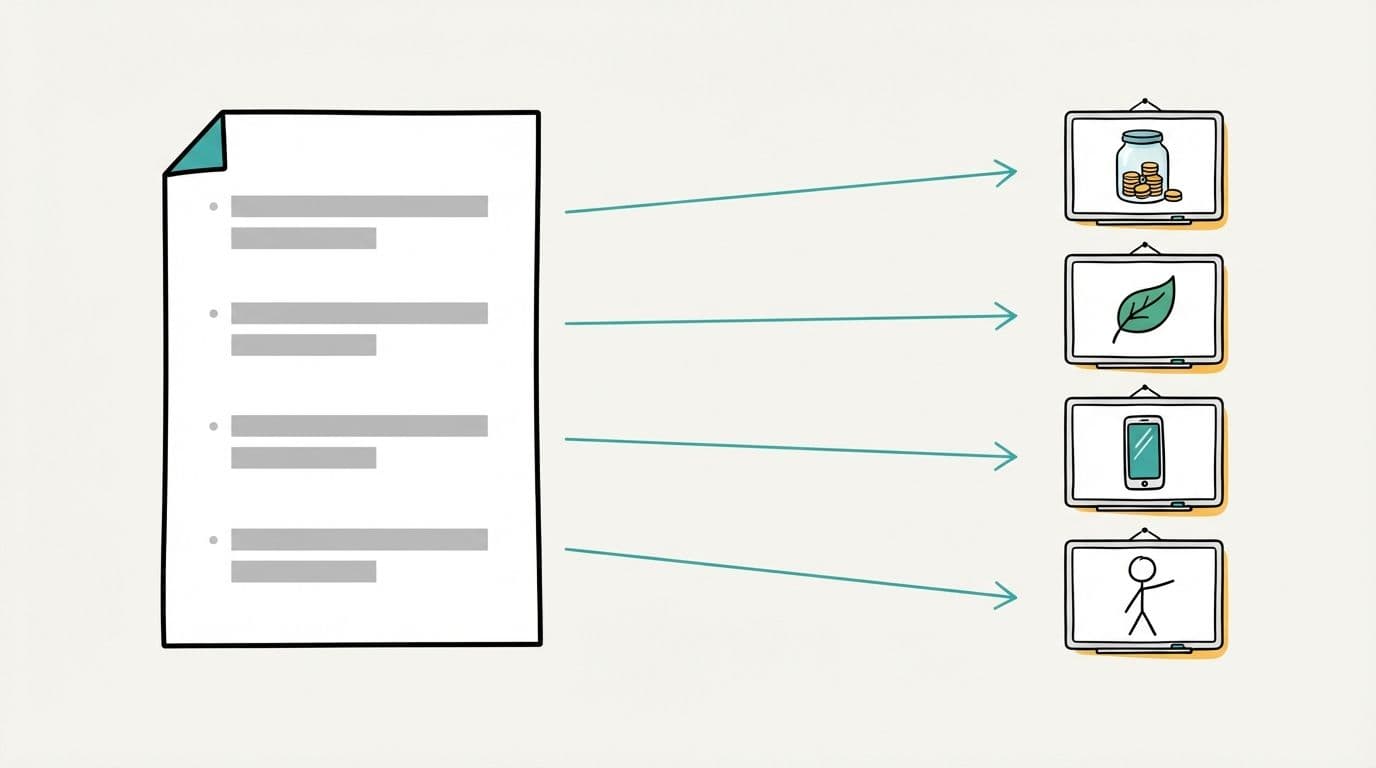
Each drawing holds one idea. The RSA mural looks busy by the end, but it was built one small sketch at a time, and each of the six videos above gives a new idea a new scene.
The drawing finishes on the word. In the compound interest short, the $100 and the $5 get separate stacks, so each one is drawn by the time the narrator moves on. When the hand runs behind the voice, the viewer stops following.
The board carries few words: a number, a label, maybe a short text card. The narration does the talking.
The format came first. The shorts frame one character or object in the middle of a tall screen; the lesson has room for a diagram with several parts. Neither crops well into the other, so decide before you write.
And the scripts sound spoken, with short sentences, “you”, and nothing a narrator would trip on. Read yours aloud before you make the video. If you run out of breath, split the sentence.
How to make a whiteboard animation like these
All six ShortsCrafter examples started as a script. To make your own, open the whiteboard video maker, paste your script (or pick a niche and let it write one), then choose the format, length, art style, voice and music. Generating takes 2 to 4 minutes on average. In the preview you can redraw any scene, add or delete scenes, and regenerate the voiceover before you render. The full process, including how to do it by hand, is in how to make a whiteboard animation.
If you’d rather have the script written for you, ShortsCrafter sizes it to the length you pick: 110 to 130 words for a 30 to 60 second short, 250 to 350 for a 1 to 2 minute horizontal video.
FAQ
What is an example of a whiteboard animation?
A narrated video where a hand draws each idea on a white background while the voice explains it. The best-known example is RSA Animate’s “Changing Education Paradigms”, a talk by Ken Robinson illustrated as one long mural. The six videos above are shorter examples for social media, lessons and training.
How long should a whiteboard animation be?
30 to 90 seconds for TikTok, Shorts and Reels. For explainers and lessons, 1 to 2 minutes per idea is a good default. Broadcast2World’s count of 1,368 whiteboard videos found a median length of 112 seconds.
What are whiteboard animations used for?
Explaining one idea clearly: lessons and course videos, employee training and onboarding, product explainers for landing pages and ads, and faceless YouTube and TikTok channels about psychology, finance, history and stories.
Which whiteboard animation style should I use?
Match it to the viewer. Minimalistic stick figures suit quick creator shorts where the idea is the draw. Regular line art with a touch of color works for explainers and training, where clarity matters more than mood. Colored suits stories, where the characters and setting carry the video.
Can I make a whiteboard animation for free?
Yes. ShortsCrafter’s free whiteboard animation maker draws any image or prompt with an animated hand and gives you a 5 to 25 second MP4. Full narrated videos like the six above use credits, from a monthly or yearly plan or a one-time pack; the pricing table lists both. By hand, a real whiteboard and a phone on a tripod cost nothing but time.