Whiteboard Animation for Marketing: Where It Works and How to Use It


Whiteboard animation for marketing means using a hand-drawn explainer to sell: a 30-second ad, the video at the top of a landing page, a clip in a sales follow-up. It works when your product is easier to draw than to film, and it falls flat when buyers need to see the real thing. Below: where whiteboard video earns its place, how long each version should run, how to script it for the channel, what to measure, and how to get several cuts from one script with ShortsCrafter.
Create a whiteboard video in minutes
Turn any idea into a hand-drawn whiteboard animation with script, voiceover and drawing done for you.
Key takeaways
- Whiteboard suits products you can’t point a camera at: software that works in the background, insurance, finance, B2B services. Physical products and anything that sells on looks are better filmed.
- One script can feed several placements. A horizontal 1 to 2 minute video goes on the landing page, and vertical 30 to 60 second cuts go to ads and social.
- Buyers ask for short videos. In Wyzowl’s 2026 survey, 63% of consumers said a short video is how they’d most like to learn about a product; 12% picked an article.
- In an ad, the first drawing has to make sense the moment it’s finished. Name the viewer’s problem in the first sentence.
- Judge each placement by its own job: conversions on a landing page, hold rate and cost per lead on ads, replies on sales emails.
- Studios quote about $500 to $4,000 or more per finished minute and 3 to 5 weeks. An AI generator gives you a draft in minutes, so testing five versions of an ad stops being a budget question.
Why whiteboard animation works for marketing
A lot of products are invisible. Payroll software, a cyber insurance policy and a bookkeeping service all look the same on screen: a dashboard, a form, a person at a laptop. A drawing can show what they do. A pile of timesheets turns into a single paycheck. A padlock closes around a laptop and little bugs bounce off it. The viewer understands the product before you’ve said its name.
The hand helps too. People keep watching a drawing until they can tell what it is, and the narration explains it while they wait. In a whiteboard video nothing moves except the line being drawn, so there’s nowhere else to look.
Viewers expect a video before they buy. Wyzowl’s State of Video Marketing 2026 (266 marketers and consumers, surveyed in late 2025) found that 96% of people have watched an explainer video to learn about a product or service, and 68% of video marketers have made one. Explainers came second only to social media videos. That’s a vendor survey with a small sample. It tells you buyers want a video; it says nothing about which style.
When to pick another format
Skip whiteboard when the product sells on how it looks or feels: food, fashion, furniture, travel, anything physical. Film it. The same goes for software whose selling point is a beautiful interface; a screen recording shows that better than a sketch of it.
Two more cases. A brand film that has to win on mood needs color and movement a plain board can’t give you. And if your brand sells on polish, a black-and-white sketch can read as a budget choice. The colored whiteboard styles soften that, but a premium brand is usually better served by full animation or live action.
Where to use whiteboard animation in your marketing
The same idea gets cut differently for each place it runs. Script length assumes a narrator reading about 150 words a minute (Broadcast2World).
Where to use whiteboard animation in your marketing
Most of this lines up with what marketers report: 71% of those in Wyzowl’s survey said videos of 30 seconds to 2 minutes work best for general marketing.
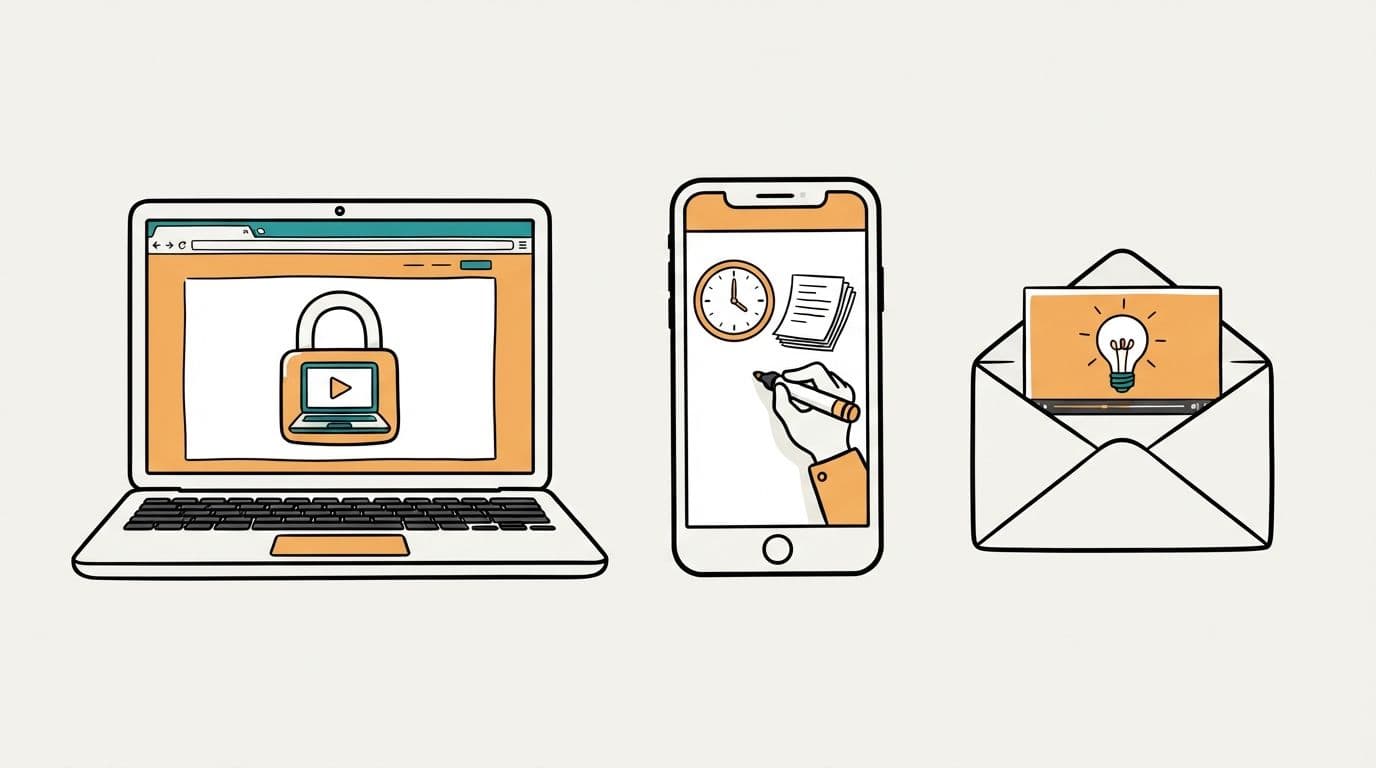
Landing page and homepage
This is the classic use. The video sits next to the sign-up button and does the job of the first two screens of copy: the problem, what the product does about it, how it works in two or three steps, and what to do next.
Pick the poster frame on purpose. Whiteboard videos start on an empty white board, and a blank white thumbnail looks like a video that failed to load. Use a frame from the middle where the main drawing is finished.
Paid social ads
Ads are where whiteboard is weakest and where it can pay off most. It’s weak because a drawing takes a second or two to appear, and on a feed you don’t have a second or two. So the first sentence names the viewer’s problem, and the first drawing is simple enough to read the moment the hand lifts: a clock, a stack of paper, an empty wallet.
It pays off because it’s cheap to change. A whiteboard scene is a few objects, so you can make three versions with three different opening lines and let the ad platform find the winner. With 2D animation, each new opening costs another round with the animator. Turn captions on, since a lot of people scroll with the sound off, and end with one action.
Organic short-form video
On TikTok, Shorts and Reels, treat the drawn video as a lesson. Teach something your buyer cares about (“why clients pay invoices late”, “what a 401(k) match actually is”) and mention the product once, at the end, or not at all. Use the same voice and art style in every post. After a few videos, people know it’s you before they read the handle.
Sales emails and follow-ups
Sales teams use 60 to 90 second videos that each answer one question that comes up on calls: how the migration works, what happens to existing data, why the price is per seat. A rep sends the video instead of writing the same paragraph for the twentieth time. Keep one question per video, so the rep can pick the right one.
Onboarding and feature launches
Marketing doesn’t stop at the sale. A short drawn video on the first login, or one that comes with a feature announcement, explains the “why” that screenshots in the help center leave out. These can run longer than ads, because the viewer has already decided they care.
How to script a whiteboard marketing video
The script decides whether the video sells. A few rules cover most of it:
- One message per video. If you can’t say what the viewer should believe after watching in one sentence, split the video.
- Open with the viewer’s problem, in their words. Your company name can wait until the product shows up as the fix.
- Write one drawable idea per sentence. “Streamline your workflow” gives the artist nothing to draw. “Three apps become one” does.
- Prefer concrete nouns: a pile of timesheets, an overdue invoice, a phone buzzing at 2 a.m.
- End with a single action: book a demo, start a trial, read the guide.
Here’s a 30-second ad script for an invoicing app, with the drawing for each line. It runs about 60 words, which leaves room for the opening drawing.
How to script a whiteboard marketing video
For the full method, with a template and a longer example, see our guide to writing a whiteboard animation script.
Making whiteboard marketing videos with ShortsCrafter
ShortsCrafter turns a script into a finished whiteboard video: it splits the script into scenes, draws each one, records the voiceover and times every drawing to its sentence. Generation takes 2 to 4 minutes on average. For marketing, the useful part is how fast you get a second and third version.
- Paste your script. It needs at least 300 characters. You can also describe the product and let ShortsCrafter write one, but for marketing you’ll usually want your own words, because you know which objection you’re answering.
- Make the landing page version first: horizontal, 1 to 2 minutes, which targets 250 to 350 words.
- Cut the script down for the vertical version: 30 to 60 seconds targets 110 to 130 words, and 60 to 90 seconds targets 170 to 190. Generate it as a separate video for ads and social.
- Pick the look and the voice. There are four art styles (minimalistic, regular, colored and stick figure). Colored stands out more in a feed; minimalistic sits better on a clean software landing page. For the voice, choose one from the library or clone your own, so every video sounds like the same company.
- Fix what’s off in the preview. You can redraw any scene, edit the description of what a scene should show, add or delete scenes, regenerate the voiceover after changing a line, and turn on subtitles for the social cuts.
- Download the video, or connect TikTok, YouTube or Instagram and schedule it.
One trade-off: the drawings are generated from your sentences, so ShortsCrafter won’t draw your exact logo or a screenshot of your app inside a scene. When you want a drawn version of your own product, upload the image to the free whiteboard animation maker. It turns a picture into a 5 to 25 second clip of a hand drawing it, in 9:16, 16:9 or 1:1, and your first one is free. Add it and your logo end card in your video editor.
What a whiteboard marketing video costs
Broadcast2World, a whiteboard studio, quotes $500 to $4,000 or more per finished minute and 3 to 5 weeks for a 60 to 120 second video. Software you run yourself costs a subscription plus the hours to build each scene. An AI generator costs a subscription or credits and minutes per draft; ShortsCrafter’s monthly and yearly plans and one-time credit packs are in the plans table.
A studio is worth it for one flagship homepage video with your exact product and characters drawn by hand. For ads it’s the wrong model. You want five versions, you’ll stop running four of them in a week, and paying per finished minute punishes exactly that. The full breakdown is in how much whiteboard animation costs.
FAQ
Is whiteboard animation good for marketing?
Yes, for products and services that are hard to film: software, finance, insurance, B2B services. It explains a process or an idea quickly and is cheap to change. For physical products, food, fashion and travel, real footage sells better.
How long should a whiteboard marketing video be?
60 seconds to 2 minutes for a landing page, 15 to 60 seconds for ads and social feeds, and 1 to 3 minutes for onboarding. At about 150 words a minute, a 90-second video needs a script of roughly 225 words.
Do whiteboard animations work for ads?
They can, if the opening is fast. Name the problem in the first sentence, make the first drawing simple, keep captions on and end with one action. Because scenes are simple, you can test several openings for the price of one.
Is whiteboard animation outdated?
The format is familiar, and that’s part of why it works: viewers know to watch the drawing. Stock clip art and a slow hand are what make a whiteboard video look dated. Custom drawings in a colored style look current.
How much does a whiteboard animation for marketing cost?
Studios quote roughly $500 to $4,000 or more per finished minute. Doing it yourself in software or with an AI generator costs a subscription and your time, which matters most when you need many versions for ads.