How to Start a Stick Figure YouTube Channel


Stick figure videos have become one of the most popular faceless formats on YouTube. Spend a few minutes in the Shorts feed and you’ll probably run into a history lesson, a psychology fact or a strange “what if” story told by a round head and four lines. Some of the platform’s best-known animated channels are built on drawings that simple. Part of the appeal is how easy they are to watch. With so little on screen, viewers stop looking for detail and listen, so a sharp joke or an odd fact lands harder than it would over stock footage. They’re also cheap to make, and AI tools have made starting one easier than ever. That’s why new stick figure channels keep appearing, and why plenty of them look the same. This guide covers how to start one that doesn’t: the niche, the channel setup, the mix of long videos and Shorts, an upload schedule YouTube will pay for, and making the videos without drawing them yourself.
Create viral faceless shorts in minutes
Pick a niche, customize the style and let AI write, voice and publish your videos on autopilot.
Key takeaways
- Pick a niche where the story matters more than the scenery: history, psychology, money, science, “what if” premises and parables all work. Product reviews and news don’t.
- From February 1, 2027, new channels need 1,000 subscribers plus 8,000 watch hours in a year (or 20 million Shorts views in 90 days) to join the YouTube Partner Program. That’s double the old watch-hour bar.
- Build the channel on horizontal videos of 8 minutes or more, and use Shorts to bring people to them. Shorts feed views don’t count toward watch hours.
- One video a week you’d defend beats a video a day. YouTube’s inauthentic content policy names “AI-generated content made with generic or unoriginal templates” as something it won’t pay for.
- Give the channel a recurring narrator character and one voice. It’s what viewers subscribe to.
What the big stick figure channels have in common
Two of the best-known stick figure channels are run by people who draw their own figures. Casually Explained has about 4.2 million subscribers and launched in December 2015. Sam O’Nella Academy has about 4.8 million subscribers from 69 videos (both per Social Blade, November 2026), and it went almost three years without an upload, from January 2020 to October 2022.
Neither channel got there through volume. Sam O’Nella averaged roughly 70,000 subscribers per video. What both have is a narrator you’d recognize from one sentence of audio: Casually Explained’s deadpan delivery, or the long-haired stick figure who narrates Sam O’Nella’s history lessons. The drawings are barely there. The writing and the voice are the channel.
That’s worth keeping in mind when guides promise a stickman channel that runs on autopilot. Software can now draw the scenes and post the video. It can’t give anyone a reason to subscribe.
Pick a niche the drawings can carry
The test is simple: can the narrator’s story be acted out by stick figures in a plain setting? If yes, the format adds something, because the viewer watches small characters react while the voice does the work. If the viewer wants to see the real thing, stick figures get in the way.
Pick a niche the drawings can carry
Skip niches that need real footage or real faces: product reviews, gaming, travel, news and reactions. News also dates before you’ve built an audience on it.
Go narrower than the table. “History” is a category; “how ordinary people lived in ancient Rome” is a channel, and someone who liked one video knows what the next one will be about. Before you commit, write down 20 video titles for the niche. If you run dry at 12, pick a wider angle. If the 20 all sound like the same video, YouTube may agree (more on that below).
Long videos or Shorts
Plan for both, but give them different jobs. Horizontal videos earn the watch hours the Partner Program asks for and can carry mid-roll ads. Vertical Shorts get the channel found.
The Partner Program bar for new channels goes up on February 1, 2027. YouTube’s announcement of the changes sets it at 1,000 subscribers plus 8,000 qualified watch hours in the last 365 days, or 20 million qualified Shorts views in the last 90 days. Until then it’s 4,000 hours or 10 million Shorts views. Channels already in the program keep their status. A channel you start this month will almost certainly apply under the new numbers.
Watch hours from the Shorts feed don’t count toward that total, so the hours have to come from horizontal videos. Say your videos run 8 minutes and people watch half of each one on average. That’s 4 minutes per view, so 8,000 hours (480,000 minutes) takes about 120,000 views across the year. Spread over 40 videos, that’s 3,000 views each. With 2-minute videos at the same rate, you’d need four times as many views.
Twenty million Shorts views in 90 days is a lot for a new channel, so treat Shorts as trailers. Cut the best minute of each long video into a vertical Short that ends by pointing to the full version.
How long each video should be
These are the lengths ShortsCrafter’s stick figure videos come in, with the script length each one needs. At regular pace, the picture changes about every 5 seconds.
How long each video should be
Eight minutes is the line that matters. On longer videos you can add mid-roll ad breaks, so one view can earn from more than one ad.
Set up your stick figure YouTube channel
Setup takes an afternoon, and two of the steps are easy to miss until they block you.
- Create the channel on a Google account you’ll keep for years, then turn on 2-Step Verification. The Partner Program requires it.
- Verify the account with a phone number in YouTube Studio. Custom thumbnails only work on verified accounts, and stick figure videos need custom thumbnails (see below).
- Choose a name and handle that say what the channel is about or who the narrator is. “Stick figure” in the name tells people the style but nothing about the content; a name built around your niche or your character ages better.
- Use your narrator character as the profile picture: the same stick figure, with the same marker (a beard, a hat, a scarf), that appears in the videos.
- Write the description for the person who just watched one video and wonders whether to subscribe. Say what topics you cover, how often you post, and what makes your take different, in two or three sentences.
- Make the banner a wide scene with your character in it. Keep anything important near the middle, because phones crop the sides.
Give the channel a narrator
Sam O’Nella’s stick figure has long hair. That’s the whole design, and it’s enough for millions of people to recognize him. A stick figure channel needs one character like that: someone who tells every story, or a recurring figure who shows up when the narrator talks about “you”.
Give the character one or two simple markers and describe them the same way every time. If your script says “the narrator in the green scarf” in one video and “our host” in the next, an AI image model has nothing to hold onto and the character drifts. The stick figure animation guide goes deeper on keeping characters consistent and writing sentences an AI can draw.
Pick one voice and stay with it. Viewers hear the voice before they’ve formed any opinion of the drawings, and a channel that changes narrators every few videos feels like several channels. If you don’t want to use your own voice on every video, a cloned voice keeps it consistent without recording each one.
Make the first video
Drawing a stick figure video by hand means a picture for every few seconds of narration, often 50 to 150 per video, each lined up with the voiceover. It’s slow work, which is part of why hand-drawn channels post rarely. A generator draws the scenes from your script, so the time goes into writing instead.
Here’s the process in ShortsCrafter’s Stick Figure Video Generator:
- Type a topic from your 20-title list, or paste a script you wrote. Pick the language, horizontal or vertical, and the length. Writing the script is free and needs no account.
- Rewrite the draft until it sounds like your narrator. Cut lines anyone could have written and add one opinion or detail only your channel would include.
- Save it to a free account and pick the look: Stick Figure has flat colors and an expressive face on every character, Stick figure v2 is plainer, with a mostly white canvas.
- Choose your channel’s voice from the library, or clone your own. Set captions and music. You see what the video will cost before you generate anything.
- Generate. Each scene gets its own drawing, matched to what the narrator is saying. It takes 2 to 4 minutes on average.
- Watch the preview, regenerate any scene that’s wrong, and export the MP4.
Make three or four videos before you publish any. Your first script will sound like a first script. By the fourth you’ll know how your narrator talks, and you’ll have a small backlog for weeks when writing goes slowly.
Thumbnails and titles
A frame from a stick figure video makes a weak thumbnail. It’s mostly white or flat color with thin lines, and it vanishes in a grid of bright, busy thumbnails. Use the style, then push it: one large stick figure with an exaggerated expression, a saturated background, and two to four words in heavy type. The expression does most of the work, because it’s the one detail a viewer can read at thumbnail size.
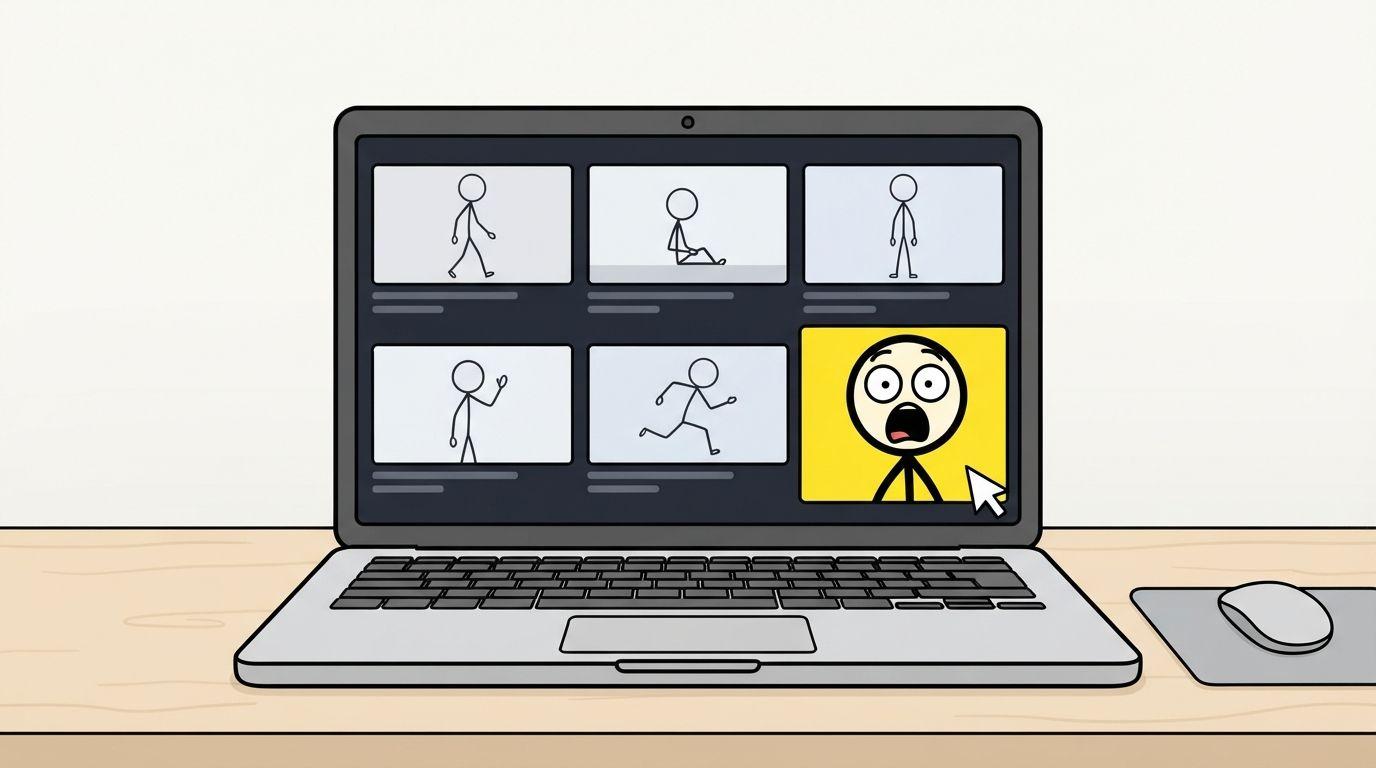
Horizontal videos made in ShortsCrafter get a thumbnail designed for them with a short headline on it. You can change the headline or upload your own picture before you publish. If you make your own, the free AI Thumbnail Maker is a quick place to try ideas.
Titles work best as the question the video answers: “Why did the Roman Empire fall?” tells the viewer what they’ll get. Save the cleverness for the script.
Plan an upload schedule YouTube will pay for
This is where most automated stick figure channels fail, so read YouTube’s channel monetization policies before you set a schedule. In July 2025 YouTube renamed its “repetitious content” rule to “inauthentic content”. The policy names “AI-generated content made with generic or unoriginal templates” as something it won’t monetize, along with videos where characters are put in the same situation over and over with the same outcome. For a stick figure channel with a recurring character, that second example is the one to watch.
A series is allowed. The same policy says videos following a set of characters across episodes are fine when each one has a distinct storyline, focus or concept. Using AI isn’t the problem either: YouTube lists using AI to visualize a character and story you invented as acceptable. The problem is sameness.
There’s also a floor from 2027. Partner Program channels count as active if they upload at least 2 long videos or 5 Shorts every 90 days (or keep 1,000 watch hours a year or 1 million Shorts views in 90 days). That’s one long video every six weeks, a pace almost any channel can hold.
A weekly schedule
This fits between those two rules:
A weekly schedule
Once the format works, ShortsCrafter’s series feature can make and post videos on a schedule (anything from twice a day to once a week) in your stick figure style and voice. Set it to weekly and watch each episode after it goes up. A channel that auto-posts a generic video every day is exactly what the inauthentic content rule was written for.
You don’t need to label stick figure videos as AI. YouTube’s disclosure label is for realistic content that could mislead viewers, and drawn, clearly unrealistic animation is exempt.
What to check after the first five videos
Two numbers in YouTube Analytics say whether the channel works: average view duration and the audience retention graph. Ignore subscriber counts for the first month.
A steep drop in the first 30 seconds means the opening didn’t deliver what the title and thumbnail promised. Start with the question, cut the intro, and put the most surprising fact first. A slow slide through the middle usually means a stretch where the same picture sits on screen too long or the script repeats itself; tighten that part next time.
Compare the five. When one topic holds people noticeably longer than the others, make the next three videos close to it. That’s how a broad niche turns into a channel people recognize.
If you have a topic in mind, put it into the Stick Figure Video Generator and read the script it writes. Plans are on the pricing table, as a monthly or yearly subscription or a one-time credit pack.
FAQ
Can a stick figure YouTube channel be monetized?
Yes. It needs to meet the Partner Program thresholds and pass YouTube’s review. From February 1, 2027, new channels need 1,000 subscribers plus 8,000 watch hours in 12 months or 20 million Shorts views in 90 days. AI-made stick figure videos qualify as long as each one is original and not a templated copy of the last.
Do stick figure videos need an AI label on YouTube?
No. The label is for realistic content that could pass as real footage or a real person. Stick figure animation is clearly unrealistic, so it doesn’t need one.
How long should stick figure YouTube videos be?
Aim for 8 to 10 minutes for the main videos, which lets you place mid-roll ads, and 60 to 90 seconds for Shorts. An 8 to 10 minute video needs a script of about 1,300 to 1,500 words.
How often should a new stick figure channel upload?
One horizontal video a week plus two or three Shorts is plenty. Sam O’Nella Academy reached about 4.8 million subscribers with 69 videos. Quality and a recognizable narrator matter more than volume.
Do I need to know how to draw to start a stick figure channel?
No. An AI generator draws each scene from your script. What you need is a script with sentences that describe something visible and a narrator with a clear voice.
Is the stick figure niche saturated?
The style is common; good stick figure channels in a specific niche aren’t. A channel about “history” competes with everyone, while a channel about how ordinary people lived in ancient Rome competes with very few.