How to Make Stickman Explainer Videos


Stickman explainer videos are everywhere right now. Spend a few minutes on YouTube and you'll find a stick figure explaining why we put things off until the last minute, or how the Roman Empire ended up split in two. The format has become a favorite of faceless channels, and it's easy to see why. Viewers find these videos easy to watch, because with so little on screen they stop looking and start listening. Creators like them because they're quick to make, even more so now that AI can do the drawing. That's also why so many new channels look alike, and why the ones that stand out are the ones with something interesting to say. This guide covers how to make stickman explainer videos people watch to the end, from the first idea to the finished video.
Create viral faceless shorts in minutes
Pick a niche, customize the style and let AI write, voice and publish your videos on autopilot.
Key takeaways
- An explainer answers one question. If you can’t write the answer in one sentence, the topic is too big for one video.
- ShortsCrafter’s stick figure pictures contain no text or charts, so every idea has to become a person doing something. Numbers go in the narration and captions.
- Plan the script in beats with a word budget. A 6 to 8 minute explainer is about 1,000 words and close to 80 scenes at Regular pace.
- Pick a concrete scene for each abstract idea before you write the line: a crowd splitting in two shows a percentage better than any chart a stick figure video can hold.
- Check every fact yourself. The drawings are simple, so viewers listen closely and notice a wrong number.
What a stickman explainer is (and when to use one)
A stickman explainer is a narrated video where stick figures act out the answer to a question. It differs from a stick figure story channel in one way: the story is there to carry an idea. The character who keeps feeding coins into a broken vending machine is funny, but he’s on screen because he’s the sunk cost fallacy in one picture.
The style works because there’s nothing to decode. A viewer reads a stick figure hiding behind a rock or counting coins in a fraction of a second, so their attention stays on what the narrator is saying. That’s also its limit. Stick figures can’t show the inside of an engine, a chart of interest rates or the layout of a battlefield in any detail. If your explanation depends on a labeled diagram, a whiteboard video will serve it better. The whiteboard explainer guide covers that format.
Pick a question the drawings can answer
Most guides say to start with one question. That’s right, but the harder part is picking a question whose answer has people in it. Before you commit, try to say the answer in one sentence and then picture three moments from it. If all three are a person doing something, the topic will draw well.
Pick a question the drawings can answer
The weak column has the same problem in each row. The answer is a list or a mechanism nobody can see, so every scene ends up as a stick figure standing next to an object, looking thoughtful. Lists of 12 also need 12 mini explainers, and each one gets about 30 seconds. Pick one item from the list and give it the whole video.
Structure the script in beats
The pages that rank for this topic give an outline at best, and none says how long each part should be. Here’s a split for a 6 to 8 minute YouTube explainer of about 1,000 words. The scene counts assume Regular pacing, where the picture changes about every 13 words.
Structure the script in beats
Treat it as a starting split. A history explainer may need a longer case and a shorter mechanism; a psychology explainer often lives on its evidence. The beat that most scripts skip is the twist, and it’s the one that makes a viewer trust the rest. An explainer that says “this bias ruins your decisions” sounds like every other video. One that adds “except when quitting costs more than finishing” sounds like someone who checked.
Keep the same character through the case and as much of the mechanism as you can. Give them one or two plain markers when they first appear, like a green scarf or a backpack, and repeat those exact words. ShortsCrafter’s image prompts reduce every character to a few flat markers like that, because detailed descriptions of faces and skin make the image model draw a realistic person instead of a stick figure.
Turn abstract ideas into scenes
This is where stickman explainers differ from other explainer formats. In ShortsCrafter the scene pictures carry no text, because the image prompts rule out captions, labels and diagrams. A percentage can’t sit on a bar chart, and a term can’t be written on a board. Every idea has to become a stick figure doing something, while the number itself goes in the narration and appears in the captions.
So for each abstract line in your script, decide on the scene first and then write the sentence that describes it.
Turn abstract ideas into scenes
The last row is the one you’ll use most. Proportions, before and after, more and fewer: stick figures show those well, as long as the narration says the exact figure. Keep spoken numbers short, like “33 of 61” or “about half”, because a viewer hears them once.
Write the sentence so it describes the scene directly. “The sunk cost fallacy affects many decisions” gives the image model nothing. “He drops in his eleventh coin and the machine still hasn’t given him a snack” draws itself.
A worked example: the sunk cost fallacy
Here’s the question beat and the start of the evidence for a sunk cost explainer, split roughly as Regular pacing would split it. The study is Hal Arkes and Catherine Blumer’s 1985 paper on the psychology of sunk cost. It was a questionnaire, so the students imagined spending the money; the video says so.
A worked example: the sunk cost fallacy
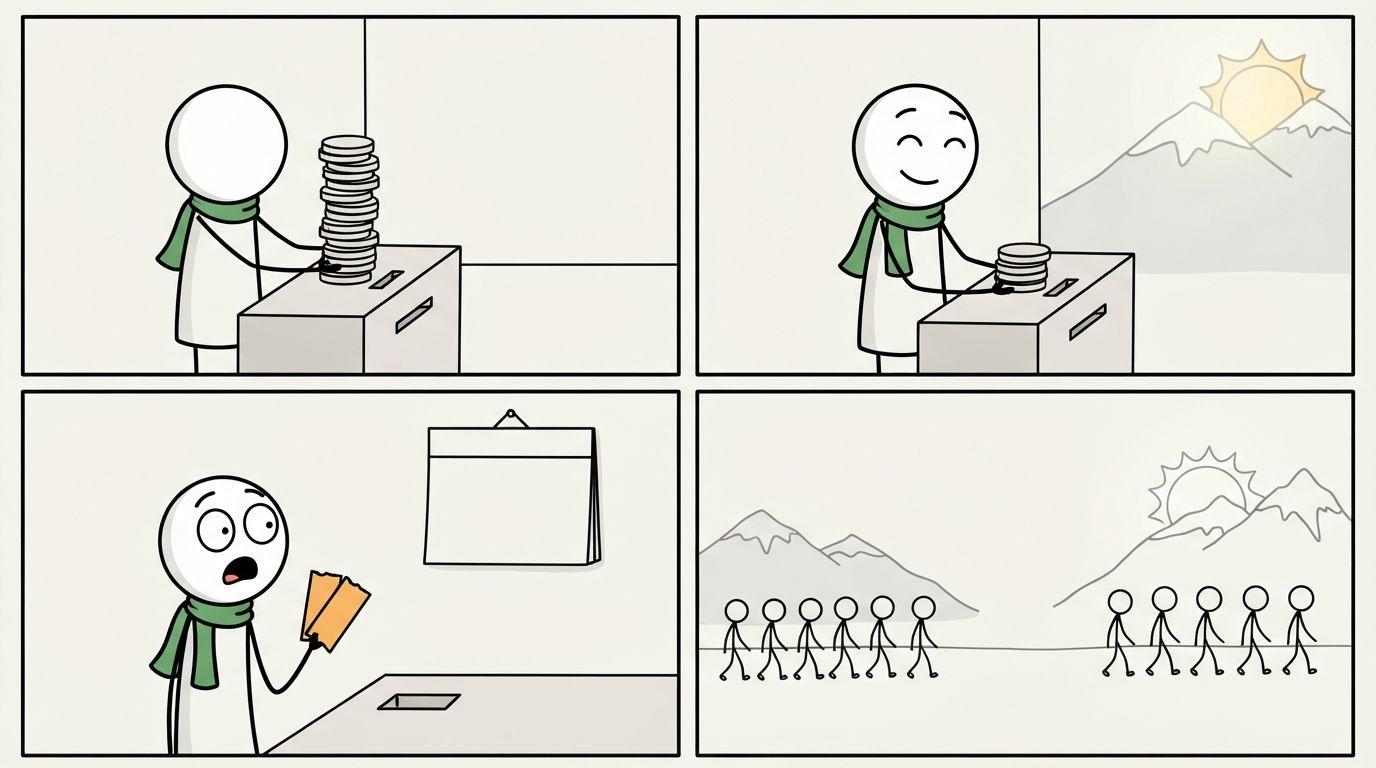
Notice that the character with the green scarf carries the first five scenes. Notice also that no scene needs a written word, and the one that holds the key result, the crowd, shows the split without a chart.
How long a stickman explainer should be
The script sets the length, and the pacing sets how many pictures you get. On YouTube, explainers usually sit in the horizontal 16:9 format. ShortsCrafter takes them from 1 to 2 minutes up to 12 to 15 minutes.
How long a stickman explainer should be
Scene counts are word counts divided by words per scene, so treat them as estimates. Fast pacing (7 words per scene) is available up to 8 minutes; above that it would pass the 200-scene limit.
Let the question set the length. A single bias fits in 4 to 6 minutes. A historical event with causes, a turning point and consequences can fill 10 to 12. Regular is the right pace for most explainers. Use Slow for calm topics like philosophy, where the viewer needs a moment with each line, and keep Fast for Shorts.
A Short can still explain something, as long as it explains one thing. Take the single most surprising fact from your long video, like the 33 of 61 students, and build a 30 to 60 second vertical video around it.
How to make a stickman explainer video, step by step
These steps use ShortsCrafter’s Stick Figure Video Generator, where the stick figure style is already selected.
- Write the script. For an explainer, paste your own under Use your text, or type the question as a topic and let AI draft it, then rewrite it beat by beat. Choose the language, the length and the 16:9 format. This step is free and doesn’t need an account.
- Save the script to a free account. The Style step opens with the stick figure look already picked.
- Choose between the two stick figure looks. Stick Figure has flat colors and an expressive face on every character, which suits explainers with a bit of humor. Stick figure v2 is plainer, with a mostly white canvas, sparse color and neutral faces unless the action calls for an expression. It suits money and science topics, where you want nothing on screen but the idea.
- Pick a voice from the library or clone your own, and set captions, music and pacing. Keep captions on for explainers: they’re where your numbers appear. The Style step shows the cost before you generate.
- Generate. The script is split into scenes, and each one gets a drawing matched to what the narrator is saying at that moment.
- Review with the sound on. Check each scene against its line, regenerate any picture that doesn’t show the idea (you can rewrite its image prompt), and add motion to the scenes where movement is the point, like a crowd splitting or a coin dropping. Add motion is charged per scene, so the pricing table is worth a look before you turn it on for all 80. Then export the MP4.
For more on writing lines the image model can draw and keeping characters consistent, see the guide on how to make stick figure animations with AI. It also covers YouTube’s rules on AI videos and templated series.
Check the facts before you upload
An AI draft of an explainer is the riskiest kind of AI draft, because the whole video rests on its claims. Open the source for every number and date, and cut any line you can’t trace to one. If a study used a questionnaire, a small group or students only, say so in a sentence. The sunk cost result above is 54 percent of 61 students answering a hypothetical question, which is still a good story and a more honest one than “most people waste money”.
Explainers on health and money need this most, since viewers may act on them. Keep those videos to how something works and leave advice for a specific person’s situation out of the script.
FAQ
Can I make a stickman explainer video for free?
You can write the script for free in ShortsCrafter’s Stick Figure Video Generator, without an account. Turning it into a video uses credits, and the Style step shows the cost before you generate anything.
How long should a stickman explainer video be?
Long enough to answer the question once. A single concept fits in 4 to 6 minutes, about 650 to 900 words. A history topic with several causes can run 10 to 12 minutes. For Shorts, pick one surprising fact and keep it to 30 to 90 seconds.
How many drawings does a stickman explainer need?
About one per 13 words at Regular pace. That’s roughly 50 to 70 scenes for a 4 to 6 minute video and 75 to 85 for a 6 to 8 minute one.
Can stick figure videos show charts or numbers?
Not in the pictures. ShortsCrafter’s stick figure scenes contain no text or charts, so numbers go in the narration and captions, and the scene shows the proportion, like a crowd splitting into two groups.
Do I need to know how to draw or animate?
No. The generator draws every scene from your script. What matters is writing each line so it describes something a stick figure can do.
What topics work best for stickman explainers?
Questions whose answer has people in it: psychology and behavior, money decisions, history and the human body. Topics that depend on labeled diagrams or detailed machinery work better as whiteboard or screen-recorded videos.