30 Stick Figure Animation Ideas for YouTube


Good stick figure animation ideas are harder to find than the drawings are to make. The style itself is old. Alan Becker’s “Animator vs. Animation” went viral on Newgrounds in the Flash days, and channels built on round heads and four lines have been pulling millions of views ever since. What’s changed is who makes them and what they make. With AI drawing the scenes, a stickman video now takes an afternoon instead of a week, and the corner of YouTube growing fastest right now is a strange one: stick figure cavemen, asking what ancient humans did all day, all night and all winter. New channels keep piling into the same handful of questions, and some of them pull millions of views while others with the same title barely get noticed. The figures are never what sets a video apart. What does is the idea, and then how it’s told. This post looks at what those channels post and why it works, then gives 30 ideas, each marked as a Short or a long video, with a note on how it opens.
Create viral faceless shorts in minutes
Pick a niche, customize the style and let AI write, voice and publish your videos on autopilot.
Key takeaways
- The stick figure channels growing fastest right now post long videos, from about 4 to 28 minutes, about ancient human daily life. Ink Explainer’s “What Did Ancient Humans Actually Do All Day?” has about 19 million views.
- The same question on three channels got 19 million, 3.4 million and 429,000 views. A proven topic isn’t enough on its own.
- A stick figure idea works when you can picture three moments of it as a person doing something. If the answer is a chart or a list, pick another format.
- None of the three channels we looked at posts Shorts. Use Shorts for one fact or one joke, and as trailers for your long videos.
- You can type any idea below into the free Stick Figure Video Generator and get a script to edit.
What popular stick figure channels are posting
We looked at three channels that post nothing but stick figure videos: Ink Explainer (about 177,000 subscribers from 22 videos), Mack (about 95,000) and Axen (about 66,000 from 32 videos). These are their most-viewed videos, with view counts checked on each channel’s Videos tab on November 21, 2026.
Most-viewed videos on three stick figure channels
Most-viewed videos on three stick figure channels
Four things stand out.
The topic is narrow. Nine of the ten are about early humans, and most take something ordinary from your own life (a boring afternoon, a rainy week, a cold night, a drink) and ask how people managed it tens of thousands of years ago. Viewers already know the modern version, so the question explains itself in the title. Outside that, the channels’ next-best topics are animals and the human body and mind: Mack’s “Why Did Your Baby Memories Disappear?” has about 361,000 views, Ink Explainer’s “Why Life Speeds Up As You Get Older?” about 176,000.
They copy each other, with very different results. “What did ancient humans do all day?” got about 19 million views on Ink Explainer, 3.4 million on Axen and 429,000 on Mack. Ancient humans and boredom has about 1.8 million on a fourth channel, GranKhelafa, and about 28,000 on Axen. A proven question is a good start, but it doesn’t carry a weak version of the video.
Every video is long. Ink Explainer’s run 4 to 21 minutes, Axen’s 5 to 23 and Mack’s mostly 18 to 28. None of the three has a single Short on its channel.
They grow on few videos. Ink Explainer passed 170,000 subscribers with 22 uploads. One video that hits does more than fifty that don’t, which is why picking the idea matters more than posting every day.
That doesn’t mean you should make a twentieth video about ancient humans’ daily routine. YouTube’s monetization policies don’t pay for content made from generic templates, and a viewer who has seen three versions of the same question won’t click a fourth. Take the pattern (an everyday experience, moved somewhere the viewer has never been) and find questions nobody on these channels has asked yet. The first section below does that.
What makes a good stick figure animation idea
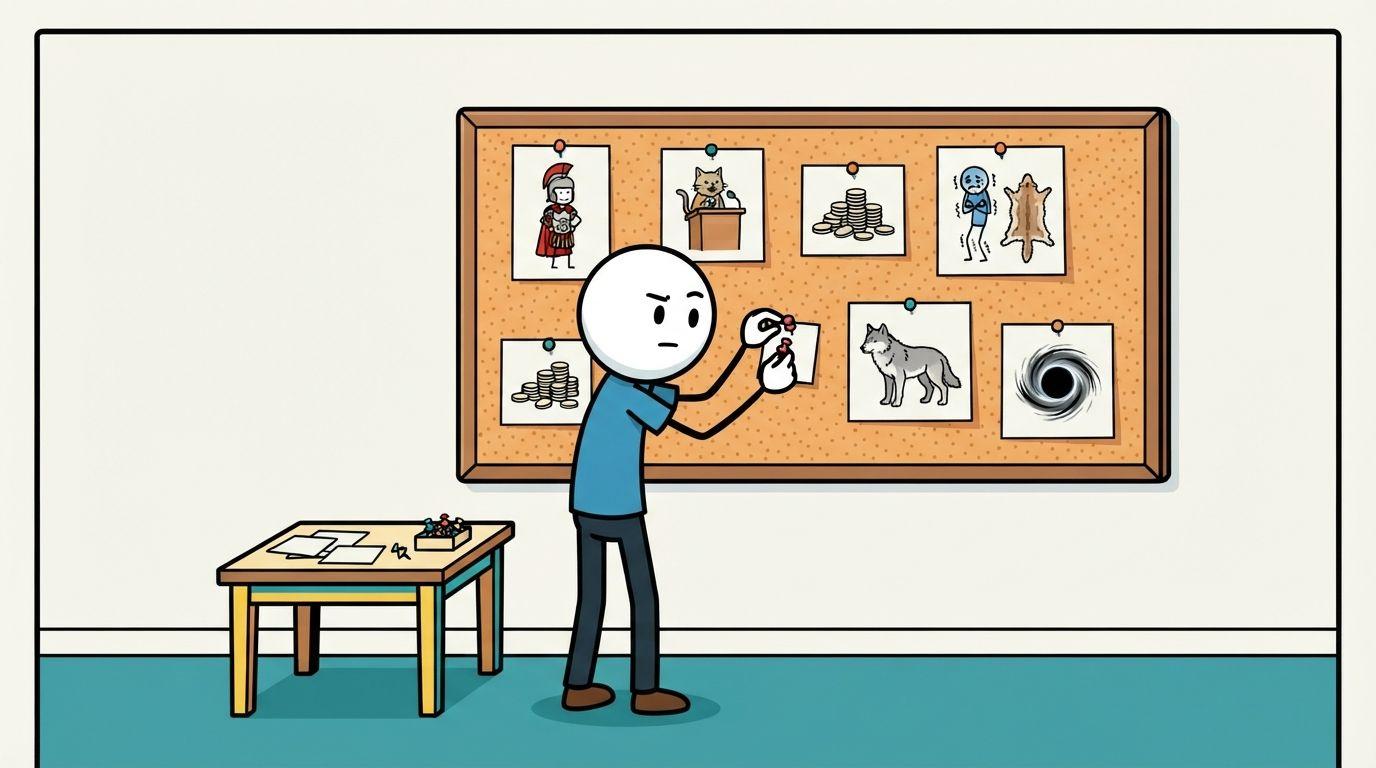
Before you commit to an idea, say the answer in one sentence and picture three scenes from it. If each scene is someone doing something (hiding behind a rock, huddling by a fire, staring at a phone at 3 a.m.), the idea will draw well. If the scenes are a stick figure standing next to a diagram, it won’t.
Stick figures keep the world plain: a few objects, a simple background, every person drawn as a stickman, historical figures included. That’s why they suit stories and explanations and struggle with anything the viewer wants to see for real, like product reviews, gameplay, travel or the news. A labeled process with many parts is better as a whiteboard video.
Short or long video
Pick the format next. A Short has room for one thing; a long video needs a story that turns at least a few times.
Short or long video
Many ideas below work as both: a long video, plus a Short cut from its best minute that points to the full version. The stick figure YouTube channel guide has the script length for each duration and how many of each to post.
Ancient human ideas
This is the niche the table is full of, so the first three ideas are the proven ones (with our own example videos) and the rest move the same pattern to questions the big channels haven’t covered yet.
1. Why did humans start wearing clothes?
Both. It’s a proven topic (about 1 million views on Mack, 404,000 on Ink Explainer), and it works as a one-minute Short too. Open on a shivering stick figure eyeing a fur pelt. The answer mixes cold, protection and showing off, and each one is its own scene. Here’s the Short made with ShortsCrafter’s stick figure style:
2. How did ancient humans handle boredom?
Long video. Everyone has been bored, so the premise lands in one line. Scenes write themselves: a figure scratching shapes on a cave wall, a group telling stories around a fire, someone carving a small figure out of bone. Keep the claims to what archaeologists have found, and say “probably” where the evidence is thin.
3. When did ancient humans start drinking alcohol?
Long video. It has a real arc: fruit that fermented on its own, early farmers, and the old argument about whether people first grew grain for bread or for beer. Each stage gets its own setting, and the figures’ faces do a lot of the work.
4. What did ancient humans do about a toothache?
Long video. Everyone knows the pain, and the evidence is surprisingly good: Neanderthal teeth with grooves worn by toothpicks, and Stone Age molars from a site in Pakistan with holes drilled in them. Open on a caveman holding his swollen cheek while the rest of the group eats.
5. What did ancient humans do when someone couldn’t hunt anymore?
Long video. The Shanidar 1 Neanderthal, found in a cave in Iraq, had a withered arm and was likely blind in one eye, yet lived for years after his injuries. Somebody fed him. A story about who looked after the old and injured has more feeling in it than another survival video, and stick figure faces carry that well.
6. How did ancient humans find their way without maps?
Long video. Stars, rivers, landmarks, and stories that worked as directions. Follow one small group crossing unknown land and getting lost once, which gives the video its middle.
7. How did ancient humans make fire?
Short. One figure, two sticks, a lot of frustration, then a flint and a lump of pyrite. It’s one clear process with a satisfying ending, which is exactly what fits in under a minute.
Survival and what if ideas
Second person turns history into a story about the viewer. Ink Explainer’s “How Long Would You Survive in Every Era of Earth?” has about 891,000 views, and the same shape works for smaller questions.
8. How long would you survive in the Ice Age?
Long video. “You” wake up on the mammoth steppe in your current clothes. Day one is the cold, day three is food, week two is meeting other people. Each stage is a new setting, and the viewer keeps score of whether they’d still be alive.
9. What if you woke up in ancient Rome?
Long video. You can’t read the signs, can’t pay with anything you have, and have to figure out where to sleep. It teaches as much history as a straight explainer and plays like a story.
10. What if the internet went down for a year?
Long video. Day one is funny (a figure tapping a dead phone), week two is a problem (no maps, no card payments), month six is a different society. Plan it in stages, each with its own setting.
11. What if cats ran the government?
Short. Pure comedy: a cat in a tiny tie at a podium, new laws about naps, a minister knocking a pen off the desk during a press conference. Cats stay cats in the pictures, so describe them as animals and keep the humans as stick figures.
Animal ideas
Animals are the channels’ second-best topic. Mack’s “Do Wild Animals Know When a Human Is Helping Them?” has about 962,000 views and “Why Are Animals Scared of Humans?” about 509,000. A stick figure next to a simply drawn animal makes the comparison with us easy to see.
12. How did wolves become dogs?
Long video. Start with a wolf hanging around a camp for scraps and end with a dog asleep on a sofa. The middle is the interesting part: which wolves came closer, and why the humans let them.
13. How do animals survive the winter?
Both. Bears sleep through it, birds leave, frogs partly freeze, and a stick figure in a thick coat watches each one with growing envy. It mirrors the ancient humans’ winter videos, which did well on all three channels.
14. Why do birds fly in a V?
Short. Each bird rides the air pushed up by the wingtips of the one in front. A 2014 study of northern bald ibises (published in Nature) found they even time their wing beats to it. Draw a stick figure on a bike drafting behind another one to make the point.
Body and mind ideas
These start from something the viewer has felt. A stick figure jolting awake or staring at a deadline is instantly recognizable, so the explanation has the viewer’s attention from the first scene.
15. Why do we get goosebumps?
Short. A figure gets cold and its arm hair stands up. The narrator explains it’s a leftover from ancestors with much more hair, for whom fluffed-up fur meant warmth (and looking bigger to a threat). Cut to a hairy ancestor doing the same thing with better results.
16. Why do you jerk awake just as you fall asleep?
Short. Nearly everyone has felt it. The cause isn’t settled, which suits a Short: show the most popular theories, one scene each, and ask viewers in the comments which one they buy.
17. What happens to your body when you skip a night of sleep?
Long video. Go hour by hour through one figure’s sleepless night and the next day: the 3 a.m. snack, the bad decision at work, the microsleep at a red light. Check every effect against a medical source, because viewers listen closely when the drawings are this simple.
18. Why we procrastinate
Both. Open on a figure with a deadline in two hours, cleaning the entire kitchen instead. The long version walks through the reasons (a task that feels bad gets avoided, the reward is far away) with a new everyday scene for each.
19. The spotlight effect: why nobody noticed your stain
Short. In a 2000 study by Thomas Gilovich and colleagues, students who wore an embarrassing T-shirt into a room badly overestimated how many people had noticed it. Draw it straight: a figure walks in wearing a loud shirt, imagines every head turning, and the reveal shows nobody looked up.
20. How long does it really take to build a habit?
Long video. The answer people quote is 21 days. In Phillippa Lally’s study at UCL, it took an average of 66 days, anywhere from 18 to 254 depending on the person and the habit. Follow one figure trying to drink a glass of water after breakfast every day, missing a day, and getting there anyway (the study found one missed day didn’t matter much).
21. Why we finish movies we hate
Short. This is the sunk cost fallacy, and a figure feeding coins into a broken vending machine shows it in one picture. End on a question to the viewer: what’s the worst thing you finished just because you’d started? The stickman explainer guide uses the same idea as its full worked script.
Money ideas
Money topics need numbers, and stick figure scenes can’t hold a chart. Put the numbers in the narration and the captions, and let the pictures show people making choices.
22. How compound interest works
Both. Two figures, one who starts saving at 25 and one at 35. Keep the money visual: a small pile of coins that grows into a hill for one of them. The long version can add fees and the cost of waiting; the Short keeps the two savers and the ending.
23. Was tulip mania really that crazy?
Long video. The classic story says people in the 1630s Netherlands traded houses for tulip bulbs and the country went broke when prices crashed. Historian Anne Goldgar’s book Tulipmania argues it was much smaller than that, with few people ruined. Tell the legend first, then check it, and the video has its twist.
24. What did people use before money?
Long video. It sits right next to the ancient humans niche. Start with the textbook story: a figure tries to swap a fish for a spear, and the other figure doesn’t want fish. Then the twist: anthropologists have found little evidence that whole communities ever ran on barter, and many think people kept track of favors and debts long before coins. A myth followed by the real answer gives the video its turn.
25. Why your paycheck is smaller than your salary
Short. A figure gets a job offer, celebrates, then opens the first paycheck and watches pieces get cut off: tax, social security, health insurance. Keep it general or name the country, because the deductions differ.
Funny everyday ideas
Comedy is the easiest place to start and the hardest to stand out in. The joke is a stick figure reacting to something every viewer has been through, which is also why these get shared.
26. Every group project ever
Short. Four figures: one who does everything, one who disappears, one who only shows up for the presentation, one who reformats the slides at midnight. Viewers tag the friend who’s the disappearing one.
27. Building flat-pack furniture
Short. The figure opens the box with confidence, reads the picture instructions upside down, and ends with a wobbly shelf and three spare screws. It’s all actions, so it draws easily.
Life lessons and philosophy ideas
These work as a character learning something: a narrator retells an old story while one figure lives it.
28. What Marcus Aurelius told himself every morning
Both. In Meditations, the Roman emperor reminds himself at the start of the day that he’ll meet meddling, ungrateful, arrogant and envious people. He decides in advance not to be angry at them. Show a stick figure emperor (with a crown as his marker) rehearsing it in bed, then a modern figure doing the same before a commute.
29. Diogenes and Alexander the Great
Short. The most powerful man in the world offers the philosopher anything he wants, and Diogenes, sitting in the sun, asks him to step aside because he’s blocking the light. Ancient writers tell the story, it may not have happened that way, and it fits in 40 seconds with a perfect last line.
30. The Stockdale paradox
Long video. James Stockdale was a US Navy pilot held as a prisoner of war in Vietnam for most of the war. In Jim Collins’s book Good to Great, he says the prisoners who didn’t make it were the optimists who kept expecting to be home by Christmas. The lesson (face the facts and still believe you’ll make it) needs a full story arc, so give it time.
Turn an idea into a video
Drawing a stick figure video by hand means a picture every few seconds of narration, often 50 to 150 drawings for one video, each lined up with the voiceover. The Stick Figure Video Generator does that part:
- Type one of the titles above as the topic, or paste a script you wrote. Choose the language, vertical or horizontal, and the length. Writing the script is free and doesn’t need an account.
- Edit the script. Cut lines anyone could have written, add one detail or opinion that’s yours, and mention each character’s marker the first time they appear.
- Save it to a free account and pick the voice, captions and music. The stick figure style is already selected, and you see the cost before you generate.
- Generate. Each scene gets its own drawing matched to the narration. Watch the preview, regenerate any scene that’s wrong, and export the MP4.
Write three scripts from one niche before you make any videos. You’ll see quickly which ideas have enough in them, and you’ll have a backlog for the weeks when writing goes slowly. The stick figure animation guide goes deeper on writing sentences an AI can draw.
FAQ
What are good stick figure animation ideas for beginners?
Start with a question about everyday life in another time, like how ancient humans made fire or dealt with a toothache. You know the modern version, the scenes are simple, and it’s the topic the biggest stick figure channels grow on. For practice, Shorts like why we get goosebumps need one setting and one character.
What stick figure videos get the most views?
On the channels we checked in November 2026, videos about early human daily life: what ancient humans did all day, in the rain, in winter, and when they started drinking or smoking. The top one, Ink Explainer’s “What Did Ancient Humans Actually Do All Day?”, had about 19 million views. Animal behavior and questions about the human body come next.
Can you make money with stick figure animations on YouTube?
Yes, through the YouTube Partner Program, as long as the videos are original. YouTube doesn’t pay for AI-generated content made from generic templates or for videos that repeat the same situation with the same outcome. A channel where each video tells its own story is fine, whether or not AI drew it.
How long should a stick figure video be?
The channels in the table post videos of about 4 to 28 minutes, and 8 minutes or more lets you add mid-roll ads. Shorts run 30 to 90 seconds and hold one idea. Pick the length the story needs: idea 15 is a Short, idea 8 isn’t.
Do I need to know how to animate to make stick figure videos?
No. An AI generator draws each scene from your script and times it to the voiceover. If you want the figures to move instead of changing picture by picture, ShortsCrafter’s Add motion setting animates the scenes for extra credits.